
Renesas’ Industry-First Gen6 <span style='color:red'>DDR5</span> Registered Clock Driver Sets Performance Benchmark by Delivering 9600 MT/s
  Renesas Electronics Corporation (TSE: 6723), a premier supplier of advanced semiconductor solutions, today announced that it has delivered the industry’s first sixth-generation Registered Clock Driver (RCD) for DDR5 Registered Dual In-line Memory Modules (RDIMMs). The new RCD is the first to achieve a data rate of 9600 Mega Transfers Per Second (MT/s), surpassing the industry standard. This breakthrough marks a significant leap from the 8800 MT/s performance of Renesas’ Gen5 RCD, setting a new standard for memory interface performance in data center servers.  Key Features of Renesas’ Gen6 DDR5 RCD  10% Bandwidth Increase over Renesas’ Gen5 RCD (9600 MT/s versus 8800 MT/s)  Backward Compatibility with Gen5 Platforms: Provides seamless upgrade path  Enhanced Signal Integrity and Power Efficiency: Enables AI, HPC, and LLM workloads  Expanded Decision Feedback Equalization Architecture: Offers eight taps and 1.5mV granularity for superior margin tuning  Decision Engine Signal Telemetry and Margining (DESTM): Improved system-level diagnostics provides real-time signal quality indication, margin visibility, and diagnostic feedback for higher speeds  The new DDR5 RDIMMs are needed to keep pace with the ever-increasing memory bandwidth demands of Artificial Intelligence (AI), High-Performance Compute (HPC) and other data center applications. Renesas has been instrumental in the design, development and deployment of the new RDIMMs, collaborating with industry leaders including CPU and memory providers, along with end customers. Renesas is the leader in DDR5 RCDs, building on its legacy of signal integrity and power optimization expertise.  “Explosive growth of generative AI is fueling higher SoC core count. This is driving unprecedented demand for memory bandwidth and capacity as a critical enabler of data center performance,” said Sameer Kuppahalli, Vice President of Memory Interface Division at Renesas. “Our sixth generation DDR5 Registered Clock Driver demonstrates Renesas’ continued commitment to memory interface innovation, path-finding and delivering solutions to stay ahead of market demand.”  "Samsung has collaborated with Renesas across multiple generations of memory interface components, including the successful qualification of Gen5 DDR5 RCD and PMIC5030,” said Indong Kim, VP of DRAM Product Planning, Samsung Electronics. “We are now excited to integrate Gen6 RCD into our DDR5 DIMMs, across multiple SoC platforms to support the growing demands of AI, HPC, and other memory-intensive workloads."  Availability  The RRG5006x Gen6 RCD is designed to meet the stringent requirements of next-generation server platforms, offering robust performance, reliability, and scalability. Renesas is sampling the new RRG5006x RCD to select customers today, including all major DRAM suppliers. Production availability is expected in the first half of 2027.
Key word:
Release time:2025-11-13 16:33 reading:444 Continue reading>>
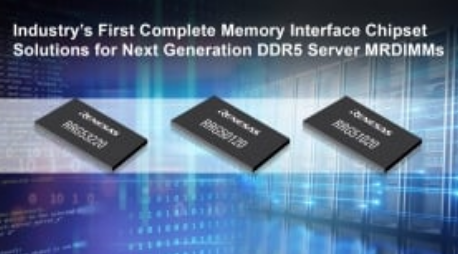
Renesas Introduces Industry’s First Complete Memory Interface Chipset Solutions for Second-Generation <span style='color:red'>DDR5</span> Server MRDIMMs
  Renesas Electronics Corporation (TSE: 6723), a premier supplier of advanced semiconductor solutions, today announced that it has delivered the industry’s first complete memory interface chipset solutions for the second-generation DDR5 Multi-Capacity Rank Dual In-Line Memory Modules (MRDIMMs).  The new DDR5 MRDIMMs are needed to keep pace with the ever-increasing memory bandwidth demands of Artificial Intelligence (AI), High-Performance Compute (HPC) and other data center applications. They deliver operating speeds up to 12,800 Mega Transfers Per Second (MT/s), a 1.35x improvement in memory bandwidth over first-generation solutions. Renesas has been instrumental in the design, development and deployment of the new MRDIMMs, collaborating with industry leaders including CPU and memory providers, along with end customers.  Renesas has designed and executed three new critical components: the RRG50120 second-generation Multiplexed Registered Clock Driver (MRCD), the RRG51020 second-generation Multiplexed Data Buffer (MDB), and the RRG53220 second-generation Power Management Integrated Circuit (PMIC). Renesas also offers temperature sensor (TS), and serial presence detect (SPD) hub solutions in mass production, making it the only memory interface company that offers the complete chipset solutions for industry standard next-generation MRDIMMs as well as all other server and client DIMMs.  “The demand for higher performance systems driven by AI and HPC applications is relentless,” said Davin Lee, Senior Vice President and General Manager of Analog & Connectivity and Embedded Processing. “Renesas is at the forefront of this trend, working with industry leaders to develop next-generation technology and specifications. These companies depend on Renesas to deliver the technical know-how and the production capabilities they require to meet unprecedented demand. Our latest chipset solutions for second-generation DDR5 MRDIMMs showcase our leadership in this market.”  Renesas’ RRG50120 second-generation MRCD is used on the MRDIMMs to buffer the Command/Address (CA) bus, chip selects and the clocks between the host controller and DRAMs. It consumes 45% less power compared to the first-generation device, a critical specification for heat management in very high-speed systems. The RRG51020 Gen2 MDB is the other key device used in the MRDIMMs to buffer data from the host CPU to DRAMs. Both the new Renesas MRCD and MDB support speeds up to 12.8 Gigabytes per Second (GB/s). Additionally, Renesas’ RRG53220 next-generation PMIC offers best-in-class electrical-over-stress protection and superior power efficiency and is optimized for high-current and low-voltage operation.  Availability  Renesas is sampling the RRG50120 MRCD, the RRG51020 MDB, and the RRG53220 PMIC now, and expects the new products to be available for production in the first half of 2025. More information on these new products is available at www.renesas.com/DDR5.  About Renesas Electronics Corporation  Renesas Electronics Corporation (TSE: 6723) empowers a safer, smarter and more sustainable future where technology helps make our lives easier. A leading global provider of microcontrollers, Renesas combines our expertise in embedded processing, analog, power and connectivity to deliver complete semiconductor solutions. These Winning Combinations accelerate time to market for automotive, industrial, infrastructure and IoT applications, enabling billions of connected, intelligent devices that enhance the way people work and live. Learn more at renesas.com. Follow us on LinkedIn, Facebook, X, YouTube, and Instagram.  (Remarks) Intel, the Intel logo, and other Intel marks are trademarks of Intel Corporation or its subsidiaries. All names of products or services mentioned in this press release are trademarks or registered trademarks of their respective owners.  The content in the press release, including, but not limited to, product prices and specifications, is based on the information as of the date indicated on the document, but may be subject to change without prior notice.
Key word:
Release time:2024-12-03 14:43 reading:1005 Continue reading>>
<span style='color:red'>DDR5</span> Runs in Rambus’ Labs
  Rambus has working silicon in its labs for DDR5, the next major interface for DRAM dual in-line memory modules (DIMMs). The register clock drivers and data buffers could help double the throughput of main memory in servers, probably starting in 2019 — and they are already sparking a debate about the future of computing.  The Jedec standards group plans to release before June the DDR5 spec as the default memory interface for next-generation servers. However, some analysts note it comes at a time of emerging alternatives in persistent memories, new computer architectures and chip stacks.  “To the best of our knowledge, we are the first to have functional DDR5 DIMM chip sets in the lab. We are expecting production in 2019, and we want to be first to market to help partners bring up the technology,” said Hemant Dhulla, a vice president of product marketing for Rambus.  DDR5 is expected to support data rates up to 6.4 Gbits/second delivering 51.2 GBytes/s max, up from 3.2 Gbits and 25.6 GBytes/s for today’s DDR4. The new version will push the 64-bit link down to 1.1V and burst lengths to 16 bits from 1.2V and 8 bits. In addition, DDR5 lets voltage regulators ride on the memory card rather than the motherboard.  In parallel, CPU vendors are expected to expand the number of DDR channels on their processors from 12 to 16. That could drive main memory sizes to 128 Gbytes from 64 GB today.  DDR5 is expected to first appear on high performance systems running large databases or memory-hungry applications such as machine learning. While some servers may lag adopting DDR5 for six months or so, “it’s just a couple quarters, not a couple years…Everyone wants a fatter memory pipe,” said Dhulla.  About 90 percent of today’s servers use registered or load-reduced DIMMs that employ register clock drivers and data buffers. The chips generally are sold for less than $5 by companies including Rambus, IDT and Montage.  The DDR5 standard will arrive about the same time Jedec releases its NVMDIMM-p interface for memory modules supporting a mix of DRAM and persistent memory. Intel said it will roll out server DIMMs next year using its 3D XPoint chips. Others are expected to ship NVMDIMM-p cards using 3D NAND.  The new cards are expected to eke out advantages in density and latency compared to traditional DRAM modules. However, they are expected to carry higher prices, and DRAMs are expected to maintain a raw speed advantage.  DDR5 “is much needed…but it still DRAM and still power hungry. It drives the traditional Von Neuman systems, but we still need to come up with persistent memory alternatives and new computing models,” said Alan Niebel, president of market watcher WebFeet Research.  Indeed, last year Hewlett-Packard Enterprise unveiled a prototype system using the GenZ memory interface that had a coming out party in August.  A lot of people don’t think DDR5 will be the next-generation memory interface,” said Gil Russell, a principal analyst at WebFeet.  Process technology shrinks for DRAMs are approaching the physical limits of its core capacitors, leading some such as Russell to project the end the memory designs in five to ten years. Higher error rates are already requiring correcting code circuitry on the chips, he noted.  The memory card sector, however, “is an area that moves really slowly. It takes a year just to get DIMMs qualified, and they are wanted at the lowest possible cost,” said Russell.  Meanwhile, high-end graphics processors from AMD and Nvidiahave already moved to High Bandwidth Memory chip stacks to boost speed and density. Dhulla of Rambus noted chip stacks are still an expensive approach limited to high-end GPUs, FPGAs and communications ASICs  “DDR5 is clearly the path to a high-volume opportunity. The big industry debate is what happens beyond DDR5, beyond 2023. Our labs are looking at multiple alternatives,” said Dhulla.
Key word:
Release time:2017-09-21 00:00 reading:1306 Continue reading>>

Turn to

/ 1

  • Week of hot material
  • Material in short supply seckilling
model brand Quote
TL431ACLPR Texas Instruments
MC33074DR2G onsemi
CDZVT2R20B ROHM Semiconductor
RB751G-40T2R ROHM Semiconductor
BD71847AMWV-E2 ROHM Semiconductor
model brand To snap up
IPZ40N04S5L4R8ATMA1 Infineon Technologies
BP3621 ROHM Semiconductor
ESR03EZPJ151 ROHM Semiconductor
TPS63050YFFR Texas Instruments
BU33JA2MNVX-CTL ROHM Semiconductor
STM32F429IGT6 STMicroelectronics
Hot labels
ROHM
IC
Averlogic
Intel
Samsung
IoT
AI
Sensor
Chip

About us

Qr code of ameya360 official account

Identify TWO-DIMENSIONAL code, you can pay attention to

AMEYA360 mall (www.ameya360.com) was launched in 2011. Now there are more than 3,500 high-quality suppliers, including 6 million product model data, and more than 1 million component stocks for purchase. Products cover MCU+ memory + power chip +IGBT+MOS tube + op amp + RF Bluetooth + sensor + resistor capacitance inductor + connector and other fields. main business of platform covers spot sales of electronic components, BOM distribution and product supporting materials, providing one-stop purchasing and sales services for our customers.

Please enter the verification code in the image below:

verification code