Renesas Sets New MCU Performance Bar with 1-GHz RA8P1 Devices with AI Acceleration

Release time:2025-07-04
author:AMEYA360
source:Renesas
reading:904
  • Unprecedented 7300+ CoreMarks1 with Dual Arm CPU cores

  • TSMC 22ULL Process Delivers High Performance and Low Power Consumption

  • Embedded MRAM with Faster Write Speeds and Higher Endurance and Retention

  • Dedicated Peripherals Optimized for Vision and Voice AI plus Real-Time Analytics

  • New AI Software Framework Eases Development and Enables Easy Migration with MPUs

  • Leading-Edge Security Features Ensure Data Privacy

  Renesas Electronics Corporation (TSE:6723), a premier supplier of advanced semiconductor solutions, introduced the RA8P1 microcontroller (MCU) Group targeted at Artificial Intelligence (AI) and Machine Learning (ML) applications, as well as real-time analytics. The new MCUs establish a new performance level for MCUs by combining 1GHz Arm® Cortex®-M85 and 250MHz Cortex-M33 CPU cores with the Arm Ethos™-U55 Neural Processing Unit (NPU). This combination delivers the highest CPU performance of over 7300 CoreMarks and AI performance of 256 GOPS at 500 MHz.
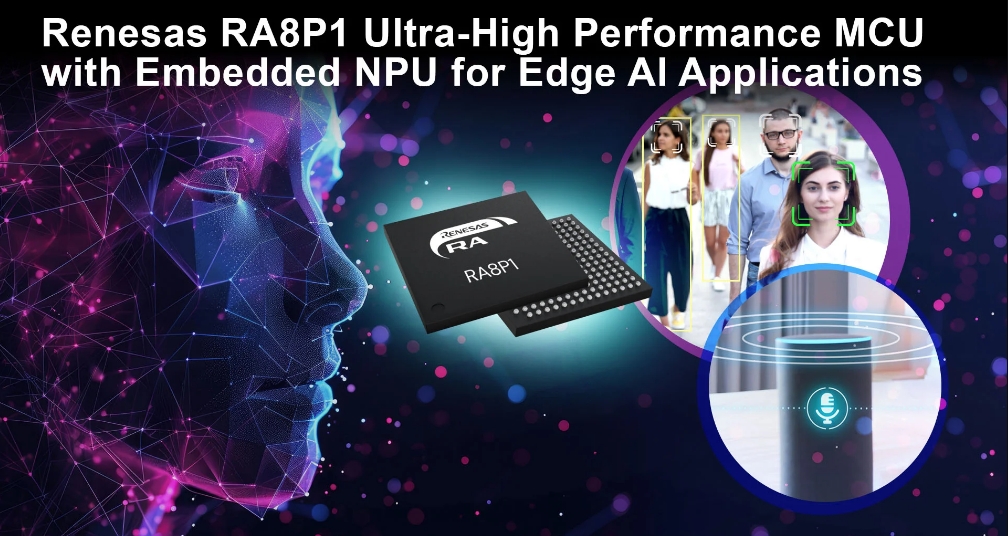
Renesas Sets New MCU Performance Bar with 1-GHz RA8P1 Devices with AI Acceleration

  Designed for Edge/Endpoint AI

  The RA8P1 is optimized for edge and endpoint AI applications, using the Ethos-U55 NPU to offload the CPU for compute intensive operations in Convolutional and Recurrent Neural Networks (CNNs and RNNs) to deliver up to 256 MACs per cycle that yield 256 GOPS performance at 500 MHz. The new NPU supports most commonly used networks, including DS-CNN, ResNet, Mobilenet TinyYolo and more. Depending on the neural network used, the Ethos-U55 provides up to 35x more inferences per second than the Cortex-M85 processor on its own.

  Advanced Technology

  The RA8P1 MCUs are manufactured on the 22ULL (22nm ultra-low leakage) process from TSMC, enabling ultra-high performance with very low power consumption. This process also enables the use of embedded Magnetoresistive RAM (MRAM) in the new MCUs. MRAM offers faster write speeds along with higher endurance and retention compared with Flash.

  “There is explosive growth in demand for high-performance edge AIoT applications. We are thrilled to introduce what we believe are the best MCUs to address this trend,” said Daryl Khoo, Vice President of Embedded Processing Marketing Division at Renesas. “The RA8P1 devices showcase our technology and market expertise and highlight the strong partnerships we have built across the industry. Customers are eager to employ these new MCUs in multiple AI applications.”

  “The pace of innovation in the age of AI is faster than ever, and new edge use cases demand ever-improving performance and machine learning on-device,” said Paul Williamson, Senior Vice President and General Manager, IoT Line of Business at Arm. “By building on the advanced AI capabilities of the Arm compute platform, Renesas’ RA8P1 MCUs meet the demands of next generation voice and vision applications, helping to scale intelligent, context-aware AI experiences.”

  “It is gratifying to see Renesas harness the performance and reliability of TSMC 22ULL embedded MRAM technology to deliver outstanding results for its RA8P1 devices,” said Chien-Hsin Lee, Senior Director of Specialty Technology Business Development at TSMC. “As TSMC continues to advance our embedded non-volatile memory (eNVM) technologies, we look forward to strengthening our long-standing collaboration with Renesas to drive innovation in future groundbreaking devices.”

  Robust, Optimized Peripheral Set for AI

  Renesas has integrated dedicated peripherals, ample memory and advanced security to address Voice and Vision AI and Real-time Analytics applications. For vision AI, a 16-bit camera interface (CEU) is included that supports sensors up to 5 megapixels, enabling camera and demanding Vision AI applications. A separate MIPI CSI-2 interface offers a low pin-count interface with two lanes, each up to 720Mbps. In addition, multiple audio interfaces including I2S and PDM support microphone inputs for voice AI applications.

  The RA8P1 offers both on-chip and external memory options for efficient, low latency neural network processing. The MCU includes 2MB SRAM for storing intermediate activations or graphics framebuffers. 1MB of on-chip MRAM is also available for application code and storage of model weights or graphics assets. High-speed external memory interfaces are available for larger models. SIP options with 4 or 8 MB of external flash in a single package are also available for more demanding AI applications.

  New RUHMI Framework

  Along with the RA8P1 MCUs, Renesas has introduced RUHMI (Renesas Unified Heterogenous Model Integration), a comprehensive framework for MCUs and MPUs. RUHMI offers efficient AI deployment of the latest neural network models in a framework agnostic manner. It enables model optimization, quantization, graph compilation and conversion, and generates efficient source code. RUHMI provides native support for machine-learning AI frameworks such as TensorFlow Lite, Pytorch & ONNX. It also provides the necessary tools, APIs, code-generator, and runtime needed to deploy a pre-trained neural network, including ready-to-use application examples and models optimized for RA8P1. RUHMI is integrated with Renesas’s own e2Studio IDE to allow seamless AI development. This integration will facilitate a common development platform for MCUs and MPUs.

  Advanced Security Features

  The RA8P1 MCUs provide leading-edge security for critical applications. The new Renesas Security IP (RSIP-E50D) includes numerous cryptographic accelerators, including CHACHA20, Ed25519, NIST ECC curves up to 521 bits, enhanced RSA up to 4K, SHA2 and SHA3. In concert with Arm TrustZone®, this provides a comprehensive and fully integrated secure element-like functionality. The new MCUs also provides strong hardware Root-of-Trust and Secure Boot with First Stage Bootloader (FSBL) in immutable storage. XSPI interfaces with decryption-on-the-fly (DOTF) allow encrypted code images to be stored in external flash and decrypted on the fly as it is securely transferred to the MCU for execution.

  Ready to Use Solutions

  Renesas provides a wide range of easy-to-use tools and solutions for the RA8P1 MCUs, including the Flexible Software Package (FSP), evaluation kits and development tools. FreeRTOS and Azure RTOS are supported, as is Zephyr. Several Renesas software example projects and application notes are available to enable faster time to market. In addition, numerous partner solutions are available to support development with the RA8P1 MCUs, including a driver monitoring solution from Nota.AI and a traffic/pedestrian monitoring solution from Irida Labs. Other solutions can be found at the Renesas RA Partner Ecosystem Solutions Page.

  Key Features of the RA8P1 MCUs

  Processors: 1GHz Arm Cortex-M85, 500MHz Ethos-U55, 250 MHz Arm Cortex-M33 (Optional)

  Memory: 1MB/512KB On-chip MRAM, 4MB/8MB External Flash SIP Options, 2MB SRAM fully ECC protected, 32KB I/D caches per core

  Graphics Peripherals: Graphics LCD controller supporting resolutions up to WXGA (1280x800), parallel RGB and MIPI-DSI display interfaces, powerful 2D Drawing engine, parallel 16bit CEU and MIPI CSI-2 camera interfaces, 32bit external memory bus (SDRAM and CSC) interface

  Other Peripherals: Gigabit Ethernet and TSN Switch, XSPI (Octal SPI) with XIP and DOTF, SPI, I2C/I3C, SDHI, USBFS/HS, CAN-FD, PDM and SSI audio interfaces, 16bit ADC with S/H circuits, DAC, comparators, temperature sensor, timers

  Security: Advanced RSIP-E50D cryptographic engine, TrustZone, Immutable storage, secure boot, tamper resistance, DPA/SPA attack protection, secure debug, secure factory programming, Device Lifecycle management

  Packages: 224BGA, 289BGA


("Note: The information presented in this article is gathered from the internet and is provided as a reference for educational purposes. It does not signify the endorsement or standpoint of our website. If you find any content that violates copyright or intellectual property rights, please inform us for prompt removal.")

Online messageinquiry

reading
Renesas丨Silicon to Software: RoX AI Studio Advances Software-Defined Vehicle Design
  Software-defined vehicles (SDV) are upending traditional automotive design. While vehicle development is still highly iterative, the industry is in the throes of a historic transformation where manufacturers are compressing once-sequential hardware-to-software design cycles into more efficient software-first design flows.  This so-called shift-left approach is exemplified by Renesas' adoption of digital tools and AI models as part of a broader digitalization and software strategy aimed at accelerating design and innovation, while simultaneously optimizing R&D efficiency. In the automotive sector, the evolution is driven by practical considerations given that a typical vehicle now embeds more than 100 million lines of code. Heavier software dependence requires continuous updating and deployment, multi-supplier integration, design validation at scale, and reflects an ecosystem where OEMs insource more software and chipmakers ship platforms, not parts. Renesas anticipated these changes with the scalable R-Car hardware and software development platform. R-Car supports the transition of E/E designs to more central processing architectures, including advanced driver assistance systems (ADAS) and autonomous vehicle design. Last year, we added R-Car Open Access (RoX), an extended platform for SDVs that provides a pre-integrated, out-of-the-box environment with hardware, operating systems, software stacks, and tools to accelerate next-generation vehicle development.  R-Car leverages a heterogeneous architecture that features Arm® CPUs with multiple hardware accelerators. RoX includes a common set of toolchains that allows software reuse across electronic control units (ECUs) for ADAS, in-vehicle information (IVI) systems, and centralized data gateways. By enabling cloud-native development and customized design simulation, the RoX platform expands SDV lifecycle support through continuous updates that align with a modern value chain where OEMs and service providers increasingly co-own software.  Introducing RoX AI Studio: Cloud-Native MLOps on R-Car  Many of our automotive customers have embraced R-Car and the Renesas RoX platform as a means to accelerate SDV development and manage the complexity of in-vehicle embedded processing systems. In doing so, we found a persistent "lab-to-road" gap between how designers employ AI training in the cloud and how they deploy new features in automotive SoCs.  RoX AI Studio, a new extension of the original RoX platform, closes that gap. The machine learning operations (MLOps) tool lets teams remotely evaluate AI models using a managed cloud control plane that connects engineers with hardware-in-the-loop (HIL) device farms so they can profile real-world performance without waiting for scarce lab boards. Continuous integration and deployment (CI/CD) keeps the full toolchain current, so improvements arrive automatically with no local installs required. The result is faster iteration, fewer surprises, and a direct line from model training to road-ready, HIL model validation.  What Is MLOps – and How Does RoX AI Studio Enable It for SDVs?  To define MLOps, it's important to understand what preceded it. MLOps builds on a concept called DevOps – short for development operations – in which tools and best practices are combined to shorten software design lifecycles. This is achieved by breaking down silos between development and IT operations teams to help them collaborate more effectively.  DevOps governs deterministic integrate/test/deploy processes for conventional software code and services. MLOps adds AI data and models, where development lifecycles are iterative, experiments branch, and choices must be tracked, compared, and promoted. By anchoring model validation on R-Car silicon, RoX AI Studio becomes the bridge between model-in-training and model-in-production, turning the art and science of AI model development into repeatable and scalable engineering operations with targeted KPIs.  RoX AI Studio operationalizes automotive MLOps for SDVs in several ways:  Model Intake and Registry: Renesas provides a curated model zoo that includes many popular AI models. Users can also use a bring your own model (BYOM) approach to ingest their own custom or proprietary models and receive a quick performance evaluation on R-Car silicon.  Automated Updates: Orchestration workflows in our MLOps tool simplify the user experience by abstracting model processing for silicon deployment, while CI/CD toolchains automate the release and deployment of the latest version of the AI toolchain for R-Car SoCs.  HIL Evaluation: MLOps in the cloud connects to a physical lab hosting an array of R-Car silicon devices that run inference experiments on demand. This allows remote validation of AI models without requiring physical co-location with the hardware.  Results and Artifacts: Collects metrics and logs from inference experiments and aggregates them as metric comparison tables and plots.  Scaled Experimentation: Runs multiple models/variants in parallel to compare accuracy vs. latency under real-world operating constraints.  Flexible Deployment: Will allow designers to begin on the Renesas cloud for speed and then mirror the same stack later in a private cloud when silicon is more widely available for individual projects.  RoX AI Studio Is Advancing Automotive's "Shift Left" Strategy  Automotive timelines are compressing. Manufacturers are moving from three to four-year platform development cycles to one to two-year cycles augmented by ongoing over-the-air (OTA) updates to provide on-road product feature enhancements. That means design teams adopting the shift-left philosophy need to test hardware and software earlier using target (remote or virtual) devices.  That's a challenge for OEMs, many of which have invested heavily in AI model training and are striving to continuously improve their networks by deploying feature updates to their vehicles in the field. At the same time, shorter development cycles mean they must test many device options simultaneously – at scale and across multiple vectors – without over-investing in the wrong development path.  When OEMs and Tier 1 suppliers use RoX AI Studio, they can quickly validate their devices by testing at scale and within the context of their specific MLOps network strategy. RoX AI Studio makes this practical by creating a simplified developer experience for managing cloud-to-lab infrastructure and automated workflows for pre-trained model deployment and evaluation on R-Car SoC targets. It runs experiments in parallel, as opposed to serially, and provides access to device farms that allow global teams to start development before boards arrive and continue at scale.  For automotive OEMs, this means earlier starts and fewer late surprises, reusable software investments that move from cloud to vehicle, and a clean path to private-cloud deployment and virtual platforms that yield better results and shorten time to market.  Platform Thinking for the Software-Defined Era  Car makers designing SDVs are committed to developing hardware and software in parallel, and the market is converging on cloud-native machine learning tools – but with no universal MLOps winner yet.  Renesas RoX AI Studio provides a standardized SDV design foundation and operationalizes AI development on that foundation by moving beyond DevOps to support a "one-stop studio" model. Together, the RoX platform and RoX AI Studio are enabling a shift-left culture change: validate earlier, iterate faster, deploy confidently.  Renesas RoX AI Studio is currently available to select customers with a broad introduction planned in 2026.
2025-12-31 17:27 reading:376
Renesas Fast-Tracks SDV Innovation with R-Car Gen 5 SoC-Based End-to-End Multi-Domain Solution Platform
  Renesas Electronics Corporation (TSE:6723), a premier supplier of advanced semiconductor solutions, is expanding its software-defined vehicle (SDV) solution offerings centered around the fifth-generation (Gen 5) R-Car family. The latest device in the Gen 5 family, the R-Car X5H is the industry’s first multi-domain automotive system-on-chip (SoC) manufactured with advanced 3nm process technology. It is capable of simultaneously running vehicle functions across advanced driver assistance systems (ADAS), in-vehicle infotainment (IVI), and gateway systems.  Renesas has begun sampling Gen 5 silicon and now offers full evaluation boards and the R-Car Open Access (RoX) Whitebox Software Development Kit (SDK) as part of the next phase of development. Renesas is also driving deeper collaboration with customers and partners to accelerate adoption. At CES 2026, Renesas will showcase AI-powered multi-domain demonstrations of the R-Car X5H in action.  The R-Car X5H leverages one of the most advanced process nodes in the industry to offer the highest level of integration, performance and power efficiency, with up to 35 percent lower power consumption than previous 5nm solutions. As AI becomes integral to next-generation SDVs, the SoC delivers powerful central compute targeting multiple automotive domains, with the flexibility to scale AI performance using chiplet extensions. It delivers up to 400 TOPS of AI performance, with chiplets boosting acceleration by four times or more. It also features 4 TFLOPS equivalent* of GPU power for high-end graphics and over 1,000k DMIPS powered by 32 Arm® Cortex®-A720AE CPU cores and six Cortex-R52 lockstep cores with ASIL D support. Leveraging mixed criticality technology, the SoC executes advanced features in multiple domains without compromising safety.  As hardware and software become more tightly integrated early in development to support complex E/E architectures, Renesas is adding new capabilities to the RoX development platform. RoX dramatically simplifies development by combining all essential hardware, operating systems, software and tools required to rapidly develop next-generation vehicles with seamless software updates.  Accelerating Automotive Innovation with an Open, Scalable RoX Whitebox SDK  To accelerate time-to-market, Renesas now offers the RoX Whitebox Software Development Kit (SDK) for the R-Car X5H, an open platform built on Linux, Android, and XEN hypervisor. Additional support for partner OS and solutions is available, including AUTOSAR, EB corbos Linux, QNX, Red Hat and SafeRTOS. Developers can jumpstart development out of the box using the SDK to build ADAS, L3/L4 autonomy, intelligent cockpit, and gateway systems. An integrated stack of AI and ADAS software enables real-time perception and sensor fusion while generative AI and Large Language Models (LLMs) enable intelligent human-machine interaction for next-generation AI cockpits. The SDK integrates production-grade application software stacks from leading partners such as Candera, DSP Concepts, Nullmax, Smart Eye, STRADVISION and ThunderSoft, supporting end-to-end development of modern automotive software architectures and faster time to market.  “Since introducing our most advanced R-Car device last year, we have been steadfast in developing market-ready solutions, including delivering silicon samples to customers earlier this year,” Vivek Bhan, Senior Vice President and General Manager of High Performance Computing at Renesas. “In collaboration with OEMs, Tier-1s and partners, we are rapidly rolling out a complete development system that powers the next generation of software-defined vehicles. These intelligent compute platforms deliver a smarter, safer and more connected driving experience and are built to scale with future AI mobility demands.”  “Integrating Renesas’ R-Car X5 generation series into our high-performance compute portfolio is a natural next step that builds on our existing collaboration,” said Christian Koepp, Senior Vice President Compute Performance at Bosch’s Cross-Domain Computing Solutions Division. “At CES 2026, we look forward to showcasing this powerful solution with Renesas X5H SoC, demonstrating its fusion capabilities across multiple vehicle domains, including video perception for advanced driver assistance systems."  “Innovative system-on-chip technology, such as Renesas’ R-Car X5H, is paving the way for ZF’s software-defined vehicle strategy,” said Dr. Christian Brenneke, Head of ZF’s Electronics & ADAS division. “Combining Renesas’ R-Car X5H with our ADAS software solutions enables us to offer full-stack ADAS capabilities with high computing power and scalability. The joint platform combines radar localization and HD mapping to provide accurate perception and positioning for reliable ADAS performance. At CES 2026, we’ll showcase our joint ADAS solution.”  First Fusion Demo on R-Car X5H with Partner Solutions at CES 2026  Renesas will showcase the capabilities of the R-Car X5H for the first time through a series of invitation-only demos at CES 2026. For more information about how to attend this event, contact sales at: CES26_Info@lm.renesas.com.  The new multi-domain demo upscales from R-Car Gen 4 to the next-generation R-Car X5H on the RoX platform, integrating ADAS and IVI stacks, RTOS, and edge AI functionality on Linux and Android with XEN hypervisor virtualization. Supporting input from eight high-resolution cameras and up to eight displays with resolutions reaching 8K2K, the platform delivers immersive visualization and robust sensor integration for next-generation SDVs. Combined with the RoX Whitebox SDK and production-grade partner software stacks, the platform is engineered for real-world deployment covering multiple automotive domains.  Availability  Renesas is shipping R-Car X5H silicon samples and evaluation boards, along with the RoX Whitebox SDK, to select customers and partners.
2025-12-24 16:06 reading:477
Renesas Releases its First Wi-Fi 6 and Wi-Fi/Bluetooth LE Combo MCUs for IoT and Connected Home Applications
  Renesas Electronics Corporation (TSE:6723), a premier supplier of advanced semiconductor solutions, today introduced the RA6W1 dual-band Wi-Fi 6 wireless microcontroller (MCU), along with the RA6W2 MCU that integrates both Wi-Fi 6 and Bluetooth® Low Energy (LE) technologies. These connectivity devices address the growing demand for always-connected, ultra-low-power IoT devices across smart home, industrial, medical and consumer applications. Renesas also launched fully integrated modules that accelerate development with built-in antennas, wireless protocol stacks, and pre-validated RF connectivity.  Ultra Low Power Operation for Always-Connected IoT  Today’s IoT devices must stay always connected to improve application usability and response time, while maintaining the lowest possible power consumption to extend battery life or to meet eco-friendly regulations. Renesas’ Wi-Fi 6 MCUs offer features such as Target Wake Time (TWT), which enables extended sleep times without compromising cloud connectivity and power consumption. This is critical for applications such as environmental sensors, smart locks, thermostats, surveillance cameras, and medical monitors, where real-time control, remote diagnostics and over-the-air (OTA) updates are critical.  Additionally, both MCU Groups are optimized for ultra-low power consumption, consuming as little as 200nA to 4µA in sleep mode and under 50µA in Delivery Traffic Indication Message (DTIM10). With the “sleepy connected” Wi-Fi functionality, these devices stay connected with minimal power draw, meeting the growing requirements of modern energy efficiency standards.  Scalable RA MCU Architecture with Full Software Support  Built on the Arm® Cortex®-M33 CPU core running at 160 MHz with 704 KB of SRAM, the MCUs enable engineers to develop cost-effective, standalone IoT applications using integrated communication interfaces and analog peripherals, without the need for an external MCU. Customers also have the option to design with a host MCU that can be selected from Renesas’ broad RA MCU offerings and attach the RA6W1 and RA6W2 as connectivity and networking add-ons. Both RA6W1 and RA6W2 are designed to work with Renesas’ Flexible Software Package (FSP) and e² studio integrated development environment. As the first Wi-Fi MCUs in the RA portfolio, they offer a scalable platform that supports seamless software reuse across the RA family.  High Performance Dual-Band Wi-Fi 6 with 2.4 and 5 GHz Connectivity  With support for both 2.4 and 5 GHz bands, both MCUs deliver superior throughput, low latency, and reduced power consumption. The dual-band capability dynamically selects the most suitable band based on real-time conditions, ensuring a stable and high-speed connection even in environments with many connected devices. Advanced features such as Orthogonal Frequency Division Multiple Access (OFDMA) and TWT boost performance and energy efficiency, making these solutions well suited for dense urban environments and battery-powered devices.  Robust Security and Matter-Certified Interoperability  The RA6W1 and RA6W2 devices offer advanced built-in security including AES-256 encryption, secure boot, key storage, TRNG, and XiP with on-the-fly decryption to keep data safe from unauthorized access. The RA6W1 is RED certified (Radio Equipment Directive), which makes it easier for developers to future-proof their design. Additionally, the device is Matter ready and certified with Matter 1.4, and is compatible across smart home platforms. Renesas supports both MCUs and modules through the Renesas Product Longevity Program, offering 15-year support for MCUs and 10 years for modules.  “We’re offering our customers the flexibility to design with a standalone Wi-Fi device, a Wi-Fi/Bluetooth LE combo, or fully integrated modules depending on their needs,” said Chandana Pairla, VP of the Connectivity Solutions Division at Renesas. “These wireless solutions save power, simplify system design and lower BOM cost. With hosted or hostless implementation options, customers can confidently begin their wireless onboarding journey and seamlessly integrate into next-generation connected systems.”  Two types of modules, Wi-Fi 6 (RRQ61001) and Wi-Fi/Bluetooth LE combo (RRQ61051) simplify design by integrating certified RF components and wireless connectivity stacks that comply with global network standards. Supported RF certification standards include the U.S. (FCC), Canada (IC), Brazil (ANATEL), Europe (CE/RED), UK (UKCA), Japan (Telec), South Korea (KCC), China (SRRC) and Taiwan (NCC). By integrating connectivity at the system level, the modules significantly reduce design effort and accelerate time to market.  Winning Combinations  Renesas offers “Advanced Low-Power Wireless HMI for Household Appliances” and “Automatic Pet Door & Tracking System” that combine the new Wi-Fi 6 MCU and Wi-Fi/Bluetooth LE MCU with numerous compatible devices from its portfolio to offer a wide array of Winning Combinations. Winning Combinations are technically vetted system architectures from mutually compatible devices that work together seamlessly to bring an optimized, low-risk design for faster time to market. Renesas offers more than 400 Winning Combinations with a wide range of products from the Renesas portfolio to enable customers to speed up the design process and bring their products to market more quickly. They can be found at renesas.com/win.  Availability  The RA6W1 MCU is now available in FCQFN and WLCSP packages, along with the RRQ61001 and RRQ61051 modules. The RA6W2 MCU (BGA package) will be available in Q1/2026. The devices are supported by the FSP, e² studio, evaluation kit and software development kit (SDK) that include flash memory, PCB trace antennas, connectors and embedded power profiler for power consumption analysis. Renesas also offers comprehensive software tools to aid system application development, as well as the Production Line Tool (PLT) for production testing of wireless MCUs.
2025-12-12 16:28 reading:651
Renesas’ Industry-First Gen6 DDR5 Registered Clock Driver Sets Performance Benchmark by Delivering 9600 MT/s
  Renesas Electronics Corporation (TSE: 6723), a premier supplier of advanced semiconductor solutions, today announced that it has delivered the industry’s first sixth-generation Registered Clock Driver (RCD) for DDR5 Registered Dual In-line Memory Modules (RDIMMs). The new RCD is the first to achieve a data rate of 9600 Mega Transfers Per Second (MT/s), surpassing the industry standard. This breakthrough marks a significant leap from the 8800 MT/s performance of Renesas’ Gen5 RCD, setting a new standard for memory interface performance in data center servers.  Key Features of Renesas’ Gen6 DDR5 RCD  10% Bandwidth Increase over Renesas’ Gen5 RCD (9600 MT/s versus 8800 MT/s)  Backward Compatibility with Gen5 Platforms: Provides seamless upgrade path  Enhanced Signal Integrity and Power Efficiency: Enables AI, HPC, and LLM workloads  Expanded Decision Feedback Equalization Architecture: Offers eight taps and 1.5mV granularity for superior margin tuning  Decision Engine Signal Telemetry and Margining (DESTM): Improved system-level diagnostics provides real-time signal quality indication, margin visibility, and diagnostic feedback for higher speeds  The new DDR5 RDIMMs are needed to keep pace with the ever-increasing memory bandwidth demands of Artificial Intelligence (AI), High-Performance Compute (HPC) and other data center applications. Renesas has been instrumental in the design, development and deployment of the new RDIMMs, collaborating with industry leaders including CPU and memory providers, along with end customers. Renesas is the leader in DDR5 RCDs, building on its legacy of signal integrity and power optimization expertise.  “Explosive growth of generative AI is fueling higher SoC core count. This is driving unprecedented demand for memory bandwidth and capacity as a critical enabler of data center performance,” said Sameer Kuppahalli, Vice President of Memory Interface Division at Renesas. “Our sixth generation DDR5 Registered Clock Driver demonstrates Renesas’ continued commitment to memory interface innovation, path-finding and delivering solutions to stay ahead of market demand.”  "Samsung has collaborated with Renesas across multiple generations of memory interface components, including the successful qualification of Gen5 DDR5 RCD and PMIC5030,” said Indong Kim, VP of DRAM Product Planning, Samsung Electronics. “We are now excited to integrate Gen6 RCD into our DDR5 DIMMs, across multiple SoC platforms to support the growing demands of AI, HPC, and other memory-intensive workloads."  Availability  The RRG5006x Gen6 RCD is designed to meet the stringent requirements of next-generation server platforms, offering robust performance, reliability, and scalability. Renesas is sampling the new RRG5006x RCD to select customers today, including all major DRAM suppliers. Production availability is expected in the first half of 2027.
2025-11-13 16:33 reading:797
  • Week of hot material
  • Material in short supply seckilling
model brand Quote
CDZVT2R20B ROHM Semiconductor
MC33074DR2G onsemi
RB751G-40T2R ROHM Semiconductor
BD71847AMWV-E2 ROHM Semiconductor
TL431ACLPR Texas Instruments
model brand To snap up
TPS63050YFFR Texas Instruments
IPZ40N04S5L4R8ATMA1 Infineon Technologies
STM32F429IGT6 STMicroelectronics
BP3621 ROHM Semiconductor
BU33JA2MNVX-CTL ROHM Semiconductor
ESR03EZPJ151 ROHM Semiconductor
Hot labels
ROHM
IC
Averlogic
Intel
Samsung
IoT
AI
Sensor
Chip
About us

Qr code of ameya360 official account

Identify TWO-DIMENSIONAL code, you can pay attention to

AMEYA360 weixin Service Account AMEYA360 weixin Service Account
AMEYA360 mall (www.ameya360.com) was launched in 2011. Now there are more than 3,500 high-quality suppliers, including 6 million product model data, and more than 1 million component stocks for purchase. Products cover MCU+ memory + power chip +IGBT+MOS tube + op amp + RF Bluetooth + sensor + resistor capacitance inductor + connector and other fields. main business of platform covers spot sales of electronic components, BOM distribution and product supporting materials, providing one-stop purchasing and sales services for our customers.

Please enter the verification code in the image below:

verification code