High lifecycles for batteries with doughnut-shaped lithium sulphide
Gartner Forecasts Worldwide Public Cloud Revenue to Grow 17.3 Percent in 2019
The worldwide public cloud services market is projected to grow 17.3 percent in 2019 to total $206.2 billion, up from $175.8 billion in 2018, according to Gartner, Inc. In 2018, Gartner forecasts that the market will grow 21 percent, up from $145.3 billion in 2017.The fastest-growing segment of the market is cloud system infrastructure services (infrastructure as a service or IaaS), which is forecast to grow 27.6 percent in 2019 to reach $39.5 billion, up from $31 billion in 2018 (see Table 1).By 2022, Gartner expects that 90 percent of organizations purchasing public cloud IaaS will do so from an integrated IaaS and platform as a service (PaaS) provider, and will use both the IaaS and PaaS capabilities from that provider."Demand for integrated IaaS and PaaS offerings is driving the next wave of cloud infrastructure adoption," said Sid Nag, research director at Gartner. “We expect that IaaS-only cloud providers will continue to exist in the future, but only as niche players, as organizations will demand offerings with more breadth and depth for their hybrid environments. Already, strategic initiatives such as digital transformation projects resulting in the adoption of multicloud and hybrid cloudfuel the growth of the IaaS market."Table 1. Worldwide Public Cloud Service Revenue Forecast (Billions of U.S. Dollars)20172018201920202021Cloud Business Process Services (BPaaS)42.246.650.354.158.1Cloud Application Infrastructure Services (PaaS)11.915.218.823.027.7Cloud Application Services (SaaS)58.872.285.198.9113.1Cloud Management and Security Services8.710.712.514.416.3Cloud System Infrastructure Services (IaaS)23.631.039.549.963.0Total Market145.3175.8206.2240.3278.3Source: Gartner (September 2018)Software as a service (SaaS) remains the largest segment of the cloud market, with revenue expected to grow 17.8 percent to reach $85.1 billion in 2019.“The increasing adoption of SaaS applications and other cloud services impacts the management, dissemination and exploitation of enterprise content,” Craig Roth, research vice president at Gartner. “Organizations are steadily — but not exclusively — shifting their content environments to SaaS. Gartner expects that by 2019, the current enterprise content management(ECM) market will devolve into purpose-built, cloud-based content solutions and solution services applications.”In the business process as a service (BPaaS) category, Gartner forecasts a revenue growth of 7.9 percent, to reach $50.3 billion in 2019. Gartner found that especially in this category, buyers increasingly expect deep domain expertise, technology and global deployment capabilities from their providers as well as service portfolios that bridge legacy offerings and support new automated, digital and cloud service delivery paradigms.
Key word:
Release time:2018-09-20 00:00 reading:3385 Continue reading>>
Worldwide semiconductor equipment billings reach $16.7B in second quarter 2018
 Worldwide Enterprise WLAN Market Maintains Moderate Growth Momentum in Second Quarter of 2018
The combined consumer and enterprise wireless local area network (WLAN) market segments rose 1.9% year over year in the second quarter of 2018 (2Q18) with worldwide revenues of $2.5 billion. According to results published in the International Data Corporation (IDC) Worldwide Quarterly WLAN Tracker, the enterprise segment grew 2.6% year over year in 2Q18 to $1.5 billion. Continued demand for network refreshes, digital transformation (DX) initiatives, and increased reliance on wireless networks for engaging with customers are positive indicators for continued growth in the second half of 2018.The 802.11ac standard now accounts for 85.2% of dependent access point unit shipments in the enterprise segment and 94.5% of dependent access point revenues, marking this standard's full penetration into the market. Beginning late in 2018 and early in 2019 the market will begin to shift toward adoption of the new 802.11ax standard.Meanwhile, consumer WLAN market revenue increased slightly, up 0.8% in 2Q18 compared to a year earlier, finishing at $1.0 billion. In 2Q18, the 802.11ac standard accounted for 49.4% of shipments and 73.9% of revenue. 802.11ac remained a bright spot in the consumer WLAN segment in 2Q18 with revenues increasing 13.1% year over year and shipments increasing 32.8%."The enterprise WLAN market continues to see moderate, steady growth, underscoring the importance of wireless networking for businesses of all sizes around the world," said Brandon Butler, senior research analyst, Network Infrastructure at IDC. "Enterprises continue to explore new ways WLAN deployments can help connect workers, enable engagement with customers, and improve business processes."From a geographic perspective, the enterprise WLAN market saw its strongest growth in 2Q18 coming from Japan, which grew 23.0% year over year, and from the Latin America region, which rose 8.9% on a year-over-year basis. Mexico, Latin America's largest market, saw a 24.5% revenue increase from a year earlier while Brazil's revenues were up 30.1% on the year. Central and Eastern Europe (CEE) also saw healthy growth rates with regional revenues increasing 6.3% compared to 2Q17. Notable CEE markets included Russia with a 7.3% year-over-year gain and Poland's with 12.9% growth.Other regions had results more in line with the worldwide average. The Asia/Pacific (excluding Japan) (APeJ) region grew 3.8% year over year in 2Q18. Standouts in the region included China, the largest market in APeJ, which grew 19.7%, and India, which increased revenues 17.9% year over year. The United States market rose 2.1% year over year. The Middle East and Africa region was nearly flat (down 0.3%) year over year, while Western Europe's WLAN market declined 2.9% compared to 2Q17. Germany, which is the largest market in the Western Europe region, saw a 7.8% year-over-year decline, while France helped hold back more dramatic declines by posting 7.9% growth."While WLAN is a fairly mature market in the U.S., many regions around the world are expected to increase their investing in wireless technology, which will help fuel growth in the broader worldwide market throughout the coming year," said Petr Jirovsky, research manager, IDC Networking Trackers. "Meanwhile, the coming introduction of 802.11ax will lead to a new wave of refresh cycles for enterprises, providing an expected boost to the market starting later this year or early next year."Key Enterprise WLAN Company HighlightsCisco's worldwide enterprise WLAN revenue increased 3.3% year over year in 2Q18 and was up 12.5% sequentially between the first and second quarters of 2018. Cisco's worldwide market share was 43.6% in 2Q18, in line with the company's 43.3% share in 2Q17. IDC believes that the Meraki cloud-managed WLAN portfolio remains one of the primary growth drivers for Cisco.Aruba-HPE (excluding its OEM business) revenues fell 10.3% year over year in 2Q18 but rose 38.9% from 1Q18. Aruba-HPE's market share stands at 15.1% in 2Q18, down from 17.2% in 2Q17.ARRIS/Ruckus continued to perform very well in 2Q18 and grew 19.3% year over year and 1.5% sequentially. ARRIS/Ruckus now accounts for 6.7% of the enterprise WLAN market, up from 5.8% in the same quarter of 2017.Ubiquiti recorded another quarter of strong growth in 2Q18, increasing 10.8% year over year. Ubiquiti accounted for 5.7% of the enterprise market in 2Q18, up from 5.3% in 2Q17.Huawei once again experienced very strong growth in 2Q18, increasing 16.0% over 2Q17 and up 42.8% sequentially from 1Q18, while claiming 5.1% market share versus its 4.5% market share in 2Q17. The IDC Quarterly WLAN Tracker provides total market size and vendor share data in an easy-to-use Excel Pivot Table format. The geographic coverage includes eight major regions (USA, Canada, Latin America, Asia/Pacific (excluding Japan), Japan, Western Europe, Central and Eastern Europe, Middle East and Africa) and 58 countries. The WLAN market is further segmented by product class, product type, product, standard, and location. Measurement for the WLAN market is provided in factory revenue, customer revenue, and unit shipments.
Key word:
Release time:2018-09-10 00:00 reading:1399 Continue reading>>
Global certification solution for worldwide IoT standards body
Key word:
Release time:2018-09-07 00:00 reading:1496 Continue reading>>
China’s semiconductor fab capacity to reach 20% worldwide share in 2020
The China IC Ecosystem Report, a comprehensive report for the IC manufacturing supply chain, reveals that front-end fab capacity in China will grow to account for 16 percent of the world’s semiconductor fab capacity this year, a share that will increase to 20 percent by the end of 2020. With the rapid growth, China will top the rest of the world in fab investment in 2020 with more than $20 billion in spending, driven by memory and foundry projects funded by both multinational and domestic companies, according to the new report released today by SEMI.The report also shows that IC Design remained the largest semiconductor sector in China for the second year in a row with $31.9 billion in revenue in 2017, widening its lead over the long-dominant IC Packaging and Test sector. The ascent of China’s IC Design sector comes as the region’s equipment market is expected to claim the top spot in 2020 for the first time on the strength of the continuing development of its domestic manufacturing capability. China’s maturing domestic fab sector is also benefiting domestic equipment and materials suppliers. Both groups continue to see gains in their product offerings and capabilities, particularly in silicon wafer production. The China IC Ecosystem Report is produced by SEMI, the global industry association and provider of independent electronics market research.The more than RMB140 billion (US$21.5 billion) accumulated by the National IC Fund, a critical component of the 2014 National Guideline to address China’s semiconductor trade deficit, has spurred rapid gains throughout the region’s IC supply chain. Semiconductors are China’s largest import by revenue. Phase 2 of funding aims to raise another RMB150-200 billion ($23.0-$30.0 billion).Encouraged by the National Guideline and favorable policies, skilled overseas talent is returning to China, triggering an explosion of domestic IC Design start-ups that are benefiting from access to investment and favorable policies, the report shows.Other highlights from The China IC Ecosystem Report include:Currently 25 new fab construction projects are underway or planned in China. 17 – 300 mm fabs are being tracked as part of this investment and expansion activity. Foundry, DRAM and 3D NAND are the leading segments for fab investment and new capacity in China.China’s IC Packaging and Test industry is also moving up the value chain by enhancing its technology offerings through mergers and acquisitions and building advanced capabilities to entice international integrated device manufacturers.China’s IC materials market, currently dominated by Packaging materials, became the second largest regional market for materials in 2016, a position it solidified in 2017. China’s materials market is expected to grow at a 10 percent CAGR from 2015 to 2019, driven primarily by the region’s new fab capacity ramp in the coming years. Fab capacity will expand at a 14 percent CAGR during that period.
Release time:2018-09-05 00:00 reading:1541 Continue reading>>
Worldwide semiconductor revenue hit record $120.8B in Q2 2018
Global semiconductor industry revenue grew 4.4 percent, quarter over quarter, in the second quarter of 2018, reaching a record $120.8 billion. Semiconductor growth occurred in all application markets and world regions, according to IHS Markit (Nasdaq: INFO).“The explosive growth in enterprise and storage drove the market to new heights in the second quarter,” said Ron Ellwanger, senior analyst and component landscape tool manager, IHS Markit. “This growth contributed to record application revenue in data processing and wired communication markets as well as in the microcomponent and memory categories.”Due to the ongoing growth in the enterprise and storage markets, sequential microcomponent sales grew 6.5 percent in the second quarter, while memory semiconductor revenue increased 6.4 percent. “Broadcom Limited experienced exceptional growth in its wired communication division, due to increased cloud and data-center demand,” Ellwanger said.Memory component revenue continued to rise in the second quarter, compared to the previous quarter, reaching $42.0 billion dollars. “This is the ninth consecutive quarter of rising revenue from memory components, and growth in the second quarter of 2018 was driven by higher density in enterprise and storage,” Ellwanger said. “This latest uptick comes at a time of softening prices for NAND flash memory. However, more attractive pricing for NAND memory is pushing SSD demand and revenue higher.”Semiconductor market shareSamsung Electronics continued to lead the overall semiconductor industry in the second quarter with 15.9 percent of the market, followed by Intel at 13.9 percent and SK Hynix at 7.9 percent. Quarter-over-quarter market shares were relatively flat, with no change in the top-three ranking. SK Hynix achieved the highest growth rate and record quarterly sales among the top three companies, recording 16.4 percent growth in the second quarter.
Key word:
Release time:2018-08-23 00:00 reading:1732 Continue reading>>
Global GDP Impact on Worldwide IC Market Growth Forecast to Rise
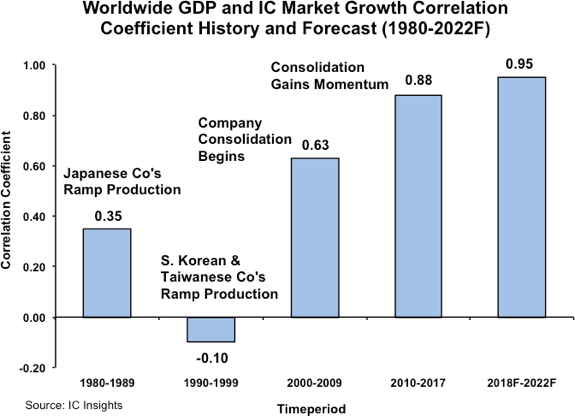
In its recently released Mid-Year Update to The McClean Report 2018, IC Insights forecasts that the 2018-2022 global GDP and IC market correlation coefficient will reach 0.95, up from 0.88 in the 2010-2017 timeperiod.  IC Insights depicts the increasingly close correlation between worldwide GDP growth and IC market growth through 2017, as well as its forecast through 2022, in Figure 1.As shown, over the 2010-2017 timeframe, the correlation coefficient between worldwide GDP growth and IC market growth was 0.88, a strong figure given that a perfect correlation is 1.0.  In the three decades previous to this timeperiod, the correlation coefficient ranged from a relatively weak 0.63 in the early 2000s to a negative correlation (i.e., essentially no correlation) of -0.10 in the 1990s.IC Insights believes that the increasing number of mergers and acquisitions, leading to fewer major IC manufacturers and suppliers, is one of major changes in the supply base that illustrate the maturing of the industry that is helping foster a closer correlation between worldwide GDP growth and IC market growth.  Other factors include the strong movement to the fab-lite business model and a declining capex as a percent of sales ratio, all trends that are indicative of dramatic changes to the semiconductor industry that are likely to lead to less volatile market cycles over the long term.In 2017, IC industry growth was greatly influenced by the “Capacity/Capital Spending Cycle Model” as the DRAM and NAND flash markets surged and served to drive total IC industry growth of 25%.  It would initially appear that the strong correlation coefficient between worldwide GDP growth and total IC market growth that had been evident from 2010 through 2016 had disappeared in 2017.  However, IC Insights does not believe that is the case.When excluding the DRAM and NAND flash segments from the IC market in 2017, the remainder of the IC market displayed an 11% increase, which closely correlates to what would be expected given a worldwide GDP increase from 2.4% in 2016 to 3.1% in 2017.  Moreover, the three-point decline in the total IC market growth rate forecast for 2018, when excluding DRAM and NAND flash (from 11% in 2017 to 8% in 2018), is expected to mirror the slight decline expected for worldwide GDP growth this year as compared to last year.  Thus, excluding the amazing surge for the DRAM and NAND flash markets in 2017 and 2018, IC Insights believes that the trend toward an increasingly close correlation between total IC market growth and worldwide GDP growth is still largely intact.Figure 1
Key word:
Release time:2018-08-01 00:00 reading:1349 Continue reading>>
STMicro Sees Strong Demand for Silicon Carbide
As STMicroelectronics reported its first quarterly results since President and CEO Jean-Marc Chery took the helm, the company was bullish about its automotive market pipeline, and especially for its silicon carbide (SiC) products from which it expects revenues of $100 million in 2018.“We have more than 25 automotive projects in discussion, and 85% of these are in SiC," Chery said. "We are preparing our capital expenditure next quarter to support this, as SiC will be an important game changer for the industry.”Asked by analysts about his confidence level in growth in the automotive and industrial sector for ST, he said, “We don’t see any weak signals, we are really confident as demand is really strong.”Chery said that the second quarter saw design wins for its third generation SiC MOSFETS and SiC diodes for car electrification in Asia and Europe, plus a custom galvanic isolation gate driver for an electric vehicle, a chipset for braking applications in Europe, ICs for engine management for Japanese and Korean customers, and an SP58 32-bit microcontroller win for a body control module for a European tier one supplying a U.S. car maker.He also said that in the personal electronics sector, while sales to its lead customer for smartphones (Apple) will see growth as it launches its new models in September, a key highlight was a design win for its STM32F7 in a high-end 4K TV at a key Japanese OEM. “This was previously a difficult market for us to penetrate,” Chery said.Second quarter net revenues and gross margin were above the mid-point of the company’s outlook. ST reported second quarter net revenues of $2.27 billion, gross margin of 40.2%, operating margin of 12.7%, and net income of $261 million or $0.29 diluted earnings per share.Asked about the potential impact of the trade war between the U.S. and China, Chery said, “At this moment, the direct impact is negligible. But we are monitoring the situation. If the trade war escalates, we are more concerned about the macro level impact on the industry, but we have nothing more to add at this stage.”Responding to questions about ST’s M&A strategy, he said that the company is continuing it strategy of organic growth for 2018, supported my small acquisitions to support areas like its STM32 products, such as its recent acquisition of Draupner Graphics. He added that the company would update the market on its M&A strategy towards the end of the year, though it may potentially make small IP company acquisitions to improve its portfolio.
Key word:
Release time:2018-07-27 00:00 reading:1472 Continue reading>>
Cloud Service Providers to Put More Emphasis on Edge Computing
Cloud computing platforms have fueled the digital transformation of enterprises in recent years. Public cloud has been playing a key role during the process. While applications of IoT and AI grow increasingly popular, the ecosystem of cloud services and the integration of cloud and edge have emerged as weak points of the market, says TrendForce. Cloud service providers have started to put more emphasis on the edge computing market, which has a CAGR of more than 30% from 2018 to 2022.TrendForce analyst Jimmy Liu points out that the digital transformation has become a must for many enterprises, who have realized the challenges brought by massive data to their current information system architectures. Cloud services like storage, data transmission and computing are on the rise, changing the mindsets of enterprises. Major cloud service providers have made eye-catching achievements in recent years, such as Amazon, Microsoft, Google, IBM, and Alibaba Cloud.However, with increasing growth momentum, the competition among cloud service providers has also become fierce. Before incorporating cloud systems into daily business operations, enterprises are bound to consider the stability, cost-effectiveness, scalability, and sustainability of cloud services, urging service providers to make the functions more integrated and prices more competitive.In addition, the rise of the Internet of Things has brought dynamic development needs. Users not only upload their systems to the cloud, but also use the cloud platforms for development and testing of IoT applications, further optimizing development costs and shortening the time for product development.Faced with existing price competition and the emerging diverse needs, cloud service providers started to extend their existing businesses and expand towards IoT platforms and edge computing. Liu notes that, most cloud service providers have established their own IoT platforms and edge computing software, such as AWS IoT Core and AWS Greengrass of Amazon, Azure IoT Solutions and Azure IoT Edge of Microsoft, etc. Based on cloud ecosystems, complete architecture and functions, as well as corresponding development tools for users, the cloud service providers have been shifting to the edge, trying to deliver more comprehensive cloud-to-end solutions on the advantages of the cloud.Cloud-to-end solutions also assist in data analysis by service providers, who used to collect existing data from applications passively. Together with a large amount of messy data, the analysis was time- and effort-consuming. However, as the cloud-to-edge development tools and ecosystems are built, they can cooperate with edge device makers more actively and have better control of these devices closer to the sources of data such as sensors, end devices, and gateways.In addition, the enhancement of edge devices will also enable cloud service providers to deploy artificial intelligence, machine learning and other technologies to the edge, and to upgrade vertical fields through various algorithms. The integration of cloud computing, edge computing and professional domain knowledge will also drive the loop of automation, autonomous training, and self-optimization. In this way, cloud service providers and edge device makers will jointly develop new forms of operation in the future to realize the digital transformation.
Key word:
Release time:2018-07-24 00:00 reading:1394 Continue reading>>

Turn to

/ 13

  • Week of hot material
  • Material in short supply seckilling
model brand Quote
RB751G-40T2R ROHM Semiconductor
BD71847AMWV-E2 ROHM Semiconductor
CDZVT2R20B ROHM Semiconductor
MC33074DR2G onsemi
TL431ACLPR Texas Instruments
model brand To snap up
BU33JA2MNVX-CTL ROHM Semiconductor
ESR03EZPJ151 ROHM Semiconductor
STM32F429IGT6 STMicroelectronics
IPZ40N04S5L4R8ATMA1 Infineon Technologies
BP3621 ROHM Semiconductor
TPS63050YFFR Texas Instruments
Hot labels
ROHM
IC
Averlogic
Intel
Samsung
IoT
AI
Sensor
Chip

About us

Qr code of ameya360 official account

Identify TWO-DIMENSIONAL code, you can pay attention to

AMEYA360 mall (www.ameya360.com) was launched in 2011. Now there are more than 3,500 high-quality suppliers, including 6 million product model data, and more than 1 million component stocks for purchase. Products cover MCU+ memory + power chip +IGBT+MOS tube + op amp + RF Bluetooth + sensor + resistor capacitance inductor + connector and other fields. main business of platform covers spot sales of electronic components, BOM distribution and product supporting materials, providing one-stop purchasing and sales services for our customers.

Please enter the verification code in the image below:

verification code