ROHM’s New SiC Schottky Barrier Diodes for High Voltage xEV Systems: Featuring a Unique Package Design for Improved Insulation Resistance

Release time:2024-11-20
author:AMEYA360
source:ROHM
reading:730

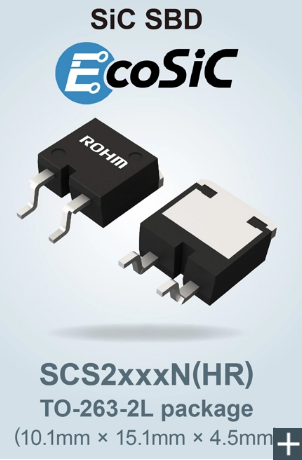
  ROHM has developed surface mount SiC Schottky barrier diodes (SBDs) that improve insulation resistance by increasing the creepage distance between terminals. The initial lineup includes eight models - SCS2xxxNHR - for automotive applications such as onboard chargers (OBCs), with plans to deploy eight models - SCS2xxxN - for industrial equipment such as FA devices and PV inverters in December 2024.
ROHM’s New SiC Schottky Barrier Diodes for High Voltage xEV Systems: Featuring a Unique Package Design for Improved Insulation Resistance

  The rapidly expanding xEV market is driving the demand for power semiconductors, among them SiC SBDs, that provide low heat generation along with high-speed switching and high-voltage capabilities in applications such as onboard chargers. Additionally, manufacturers increasingly rely on compact surface mount devices (SMDs) compatible with automated assembly equipment to boost manufacturing efficiency. Compact SMDs tend to typically feature smaller creepage distances, fact that makes high-voltage tracking prevention a critical design challenge.

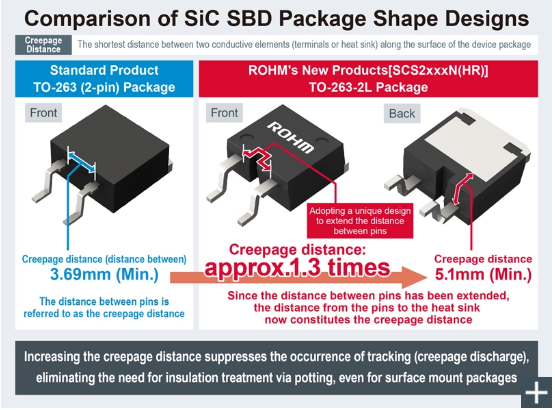
  As leading SiC supplier, ROHM has been working to develop high-performance SiC SBDs that offer breakdown voltages suitable for high-voltage applications with ease of mounting. Adopting an optimized package shape, it achieves a minimum creepage distance of 5.1mm, improving insulation performance when contrasted with standard products.
ROHM’s New SiC Schottky Barrier Diodes for High Voltage xEV Systems: Featuring a Unique Package Design for Improved Insulation Resistance

  The new products utilize an original design that removes the center pin previously located at the bottom of the package, extending the creepage distance to a minimum of 5.1mm, approx. 1.3 times greater than standard products. This minimizes the possibility of tracking (creepage discharge) between terminals, eliminating the need for insulation treatment through resin potting when surface mounting the device on circuit boards in high voltage applications. Additionally, the devices can be mounted on the same land pattern as standard and conventional TO-263 package products, allowing an easy replacement on existing circuit boards.

  Two voltage ratings are offered, 650V and 1200V, supporting 400V systems commonly used in xEVs as well as higher voltage systems expected to gain wider adoption in the future. The automotive-grade SCS2xxxNHR are AEC-Q101 qualified, ensuring they meet the high reliability standards this application sector demands.

  Going forward, ROHM will continue to develop high-voltage SBDs using SiC, contributing to low energy consumption and high efficiency requirements in automotive and industrial equipment by providing optimal power devices that meet market needs.

  Application Examples◇ Automotive applications: Onboard chargers (OBCs), DC-DC converters, etc.

  ◇ Industrial Equipment: AC servo motors for industrial robots, PV inverters, power conditioners, uninterruptible power supplies (UPS), and more

  Online Sales InformationAvailability: The SCS2xxxxNHR for automotive applications are available now.

  The SCS2xxxN for industrial equipment are scheduled in December 2024.

  Pricing: $10.50/unit (samples, excluding tax)

  Online Distributors: DigiKey™, Mouser™ and Farnell™

  The products will be offered at other online distributors as they become available.

  EcoSiC™ BrandEcoSiC™ is a brand of devices that leverage silicon carbide, which is attracting attention in the power device field for performance that surpasses silicon. ROHM independently develops technologies essential for the advancement of SiC, from wafer fabrication and production processes to packaging, and quality control methods. At the same time, we have established an integrated production system throughout the manufacturing process, solidifying our position as a leading SiC supplier.

ROHM’s New SiC Schottky Barrier Diodes for High Voltage xEV Systems: Featuring a Unique Package Design for Improved Insulation Resistance

  TerminologyCreepage Distance

  The shortest distance between two conductive elements (terminals) along the surface of the device package. In semiconductor design, insulation measures with such creepage and clearance distances must be taken to prevent electric shocks, leakage currents, and short-circuits in semiconductor products.

  Tracking (Creepage Discharge)

  A phenomenon where discharge occurs along the surface of the package (insulator) when high voltage is applied to the conductive terminals. This can create an unintended conductive path between patterns, potentially leading to dielectric breakdown of the device. Package miniaturization increases the risk of tracking by reducing creepage distance.

  Resin Potting

  The process of encapsulating the device body and the electrode connections between the device and circuit with resin, such as epoxy, to provide electrical insulation. This provides durability and weather resistance by protecting against water, dust, and other environmental conditions.

  AEC-Q101 Automotive Reliability Standard

  AEC stands for Automotive Electronics Council, a reliability standard for automotive electronic components established by major automotive manufacturers and US electronic component makers. Q101 is a standard that specifically applies to discrete semiconductor products (i.e. transistors, diodes).

("Note: The information presented in this article is gathered from the internet and is provided as a reference for educational purposes. It does not signify the endorsement or standpoint of our website. If you find any content that violates copyright or intellectual property rights, please inform us for prompt removal.")

Online messageinquiry

reading
ROHM launches wide SOA MOSFET for AI servers in compact 5×6mm package
  ROHM has developed the 100V power MOSFET - RS7P200BM - achieving industry-leading SOA in a 5060-size (5.0mm × 6.0mm) package. This product is ideal for hot-swap circuits in AI servers using 48V power supplies as well as for industrial power supplies requiring battery protection.  The rapid evolution and widespread adoption of AI technologies have increased the demand for stable operation and improved power efficiency in servers equipped with generative AI and high-performance GPUs. Particularly in hot-swap circuits, power MOSFETs with wide SOA are essential to handle inrush current and overload conditions, ensuring stable operation. Furthermore, within data centers and AI servers, the transition towards 48V power supplies, which offer superior power conversion efficiency, is progressing against a backdrop of energy conservation. This necessitates the development of high-voltage, high-efficiency power supply circuits capable of meeting these demands.  Therefore, ROHM has expanded its line-up of 100V power MOSFETs ideal for hot-swap circuits in AI servers to meet market demand. The new RS7P200BM adopts a compact DFN5060-8S (5060 size) package, enabling even higher density mounting compared to the AI server power MOSFET ‘RY7P250BM’ in the DFN8080-8S (8.0mm × 8.0mm size) package, which ROHM has released in May 2025.  The new product achieves a low on-resistance (RDS(on)) of 4.0mΩ (conditions: VGS=10V, ID=50A, Ta=25°C) while maintaining wide SOA of 7.5A at a pulse width of 10ms and 25A at 1ms under operating conditions of VDS=48V. This balance of low on-resistance and wide SOA, typically a trade-off relationship, helps suppress heat generation during operation, thereby improving server power supply efficiency, reducing cooling load, and lowering electricity costs.  Mass production of the new product began in September 2025 (sample price: $5.5/unit, excluding tax).  ROHM will continue to expand its product lineup for 48V power supplies, which are increasingly adopted in applications such as AI servers. By providing highly efficient and reliable solutions, we will contribute to reducing power loss and cooling loads in data centers, as well as enhancing the high reliability and energy efficiency of server systems.  Application Examples  •48V system AI servers and data center power hot-swap circuits  •48V system industrial power supplies (forklifts, power tools, robots, fan motors, etc.)  •Battery-powered industrial equipment such as AGVs (Automated Guided Vehicles)  •UPS, emergency power systems (battery backup units)  EcoMOS™ Brand  EcoMOS™ is ROHM's brand of silicon power MOSFETs designed for energy-efficient applications in the power device sector. Widely utilized in applications such as home appliances, industrial equipment, and automotive systems, EcoMOS™ provides a diverse lineup that enables product selection based on key parameters such as noise performance and switching characteristics to meet specific requirements.  ・EcoMOS™ is a trademark or registered trademark of ROHM Co., Ltd.  Terminology  SOA(Safe Operating Area)  The voltage and current range within which a device can operate safely without damage. Operation beyond this safe operating area may cause thermal runaway or damage; therefore, consideration of the SOA is essential, particularly in applications where inrush current or overcurrent may occur.  Hot-swap circuit  The complete circuitry supports the hot-swap function, which enables the removal or insertion of components while the device's power supply remains active. Comprising MOSFETs, protective elements, and connectors, it suppresses inrush currents occurring during component insertion and provides overcurrent protection, thereby ensuring the safe operation of the system and connected components.  Inrush Current  The high current exceeds the rated current value that flows momentarily when switching on electronic equipment. Controlling this prevents damage to devices and stabilizes the system by reducing the load on components within the power supply circuit.  On-resistance(RDS(on))  The resistance value between the drain and source terminals when the MOSFET is in operation (on). The lower the value, the less power loss occurs during operation.
2025-11-28 17:28 reading:289
ROHM’s Three-Phase Brushless DC Motor Gate Driver Achieving FET Heat Reduction while Suppressing EMI
  ROHM has developed the “BD67871MWV-Z” three-phase brushless DC motor gate driver for medium voltage applications (12 to 48V systems). By incorporating ROHM’s proprietary gate drive technology TriC3™, it greatly reduces FET’s switching loss while maintaining low EMI – traditionally a trade-off in motor driver ICs.  Motors account for approximately 60% of global electricity consumption, making control technology which affects energy efficiency, increasingly critical. In 12V to 48V motor drive applications, a simple configuration where an MCU controls three gate drivers has been the mainstream. However, in recent years, demands for high efficiency and precise control have grown, accelerating the adoption of solutions combining an MCU with an integrated three-phase motor driver. Further, a technical challenge in three-phase motor drivers has been the trade-off between “power consumption reduction” and “noise / EMI (electro-magnetic interference) reduction,”.  BD67871MWV-Z features ROHM's proprietary Active Gate Drive technology “TriC3™”, which rapidly senses voltage information from the external power FETs and adjust gate drive current accordingly in real-time. This greatly reduces FETs’ switching loss (and hence heat generation) FET power consumption during switching while simultaneously suppressing ringing to achieve low EMI.  Compared to ROHM's conventional constant-current drive products, TriC3™ gate drive has been demonstrated in actual motors that FET heat generation by approximately 35% while maintaining equivalent EMI levels. Furthermore, BD67871MWV-Z adopts UQFN28 package and pin layout which are commonly used in motor driver ICs for medium-voltage industrial equipment applications, contributing to reduced engineering effort required in circuit modifications and new designs.  Mass production of the new product commenced in September 2025 (sample price: $5.5/unit, tax excluded).  ROHM also offer general-purpose motor drivers (BD67870MWV-Z, BD67872MWV-Z) with the same package and pin configuration as the new product, designed for constant-voltage drive. From general-purpose types to the value-added types featuring the new TriC3™, we offer a comprehensive product lineup to supports a wide variety of applications and use cases. We are committed to contributing to improved motor efficiency, enhanced application functionality, and reduced power consumption.  Application Examples  •Industrial Equipment: Various motors such as electric drills/drivers and industrial fans  •Consumer Appliances: Various motors used in vacuum cleaners, air purifiers, air conditioners, ventilation fans and E-bikes (electric-assist sports bicycles)  TriC3™  A multi-step constant current drive technology developed by ROHM. By controlling gate current in three steps, it achieves high-speed, high-efficiency operation while minimizing EMI by suppressing ringing.  • TriC3™ is a trademark or registered trademark of ROHM Co., Ltd.  Terminology  EMI (Electromagnetic Interference)  EMI is used as an indicator of how much noise a product generates during operation, potentially causing malfunctions in surrounding ICs or systems. “Low EMI” means the product generates less noise.  Ringing  High-frequency oscillations or overshoot occurring during switching. This arises from the resonation between inductance and capacitance, including parasitic elements in the circuit. In the context of motor driving, ringing happens when the power MOSFETs are turned on and off.
2025-11-21 16:54 reading:325
Now Standard in Siemens’ Flotherm™! ROHM Expands Its High-Accuracy EROM Models for Shunt Resistors
  ROHM has expanded its lineup of EROM (Embeddable BCI-ROM) models for shunt resistors and has made them available on ROHM’s website. In addition, these models are now standard in Siemens’ electronic thermal design software, Simcenter™ Flotherm™*.  ROHM’s shunt resistors are widely used in automotive and industrial equipment applications, where their high-accuracy current detection and superior reliability are highly valued. We have added the PMR series to the EROM lineup, alongside the previously available PSR series.  The EROM models achieve high accuracy with a measurement deviation within ±5% for both surface temperature (ΔT) and thermal resistance, enabling thermal analysis that closely reflects actual operating conditions. This contributes to improved simulation accuracy in the thermal design phase and enhances overall development efficiency.  Furthermore, by standard implementation in Simcenter™ Flotherm™, these models make it easier for component manufacturers and set manufacturers to share thermal analysis data. This allows for highly accurate and efficient simulations while maintaining the confidentiality of proprietary information.  Going forward, ROHM will continue to enhance the support for customers’ design and development activities through both its high-performance components and advanced simulation models.  *Standard in Simcenter™ Flotherm™ 2510 and later.  Terminology  EROM (Embeddable BCI-ROM)  A reduced-order model that can be used within Simcenter™ Flotherm™ to perform thermal simulations. It allows sharing while keeping internal component structures (confidential design data) hidden, enabling fast and highly accurate analysis.  Simcenter™ Flotherm™  A CFD (Computational Fluid Dynamics) simulator developed by Siemens, specialized in thermal and cooling design for electronic devices. It enables fast and accurate thermal analysis from the early design stage through validation, supporting exceptionally reliable thermal design.  Simcenter™ Flotherm™ is a registered trademark of Siemens.
2025-11-21 16:50 reading:300
ROHM Develops Breakthrough Schottky Barrier Diode Combining Low VF and IR for Advanced Image Sensor Protection
  ROHM has developed an innovative Schottky barrier diode that overcomes the traditional VF / IR trade-off. This way, it delivers high reliability protection for a wide range of high-resolution image sensor applications, including ADAS cameras.  Modern ADAS cameras and similar systems require higher pixel counts to meet the demand for greater precision. This has created a growing concern – the risk of damage caused by photovoltaic voltage generated under light exposure during power OFF. While low-VF SBDs are effective countermeasures, low IR is also essential during operation to prevent thermal runaway. However, simultaneously achieving both low VF and IR has been a longstanding technical challenge. ROHM has overcome this hurdle by fundamentally redesigning the device structure – successfully developing an SBD that combines low VF with low IR which is ideal for protection applications.  The RBE01VYM6AFH represents a novel concept: leveraging the low-VF characteristics of rectification SBDs for protection purposes. By adopting a proprietary architecture, ROHM has achieved low IR that is typically difficult to realize with low VF designs. As a result, even under harsh environmental conditions, the device meets market requirements by delivering VF of less than 300mV (at IF=7.5mA even at Ta=-40°C), and an IR of less than 20mA (at VR=3V even at Ta=125°C.) These exceptional characteristics not only prevent circuit damage caused by high photovoltaic voltage generated when powered OFF, but also significantly reduce the risk of thermal runaway and malfunction during operation.  The diode is housed in a compact flat-lead SOD-323HE package (2.5mm × 1.4mm / 0.098inch × 0.055inch) that offers both space efficiency and excellent mountability. This enables support for space-constrained applications such as automotive cameras, industrial equipment, and security systems. The RBE01VYM6AFH is also AEC-Q101 qualified, ensuring suitability as a protection device for next-generation automotive electronics requiring high reliability and long-term stability.  Going forward, ROHM will focus on expanding its lineup with even smaller packages to address continuing miniaturization demands.  Key Specifications  Application Examples  Image sensor-equipped sets such as ADAS cameras, smart intercoms, security cameras, and home IoT devices.  Terminology  Photovoltaic Voltage  A term commonly used with optical sensors, referring to the voltage produced when exposed to light. In general, the stronger the light intensity or higher the pixel count the greater voltage generated.
2025-10-27 16:49 reading:448
  • Week of hot material
  • Material in short supply seckilling
model brand Quote
RB751G-40T2R ROHM Semiconductor
MC33074DR2G onsemi
BD71847AMWV-E2 ROHM Semiconductor
TL431ACLPR Texas Instruments
CDZVT2R20B ROHM Semiconductor
model brand To snap up
TPS63050YFFR Texas Instruments
STM32F429IGT6 STMicroelectronics
BP3621 ROHM Semiconductor
IPZ40N04S5L4R8ATMA1 Infineon Technologies
ESR03EZPJ151 ROHM Semiconductor
BU33JA2MNVX-CTL ROHM Semiconductor
Hot labels
ROHM
IC
Averlogic
Intel
Samsung
IoT
AI
Sensor
Chip
About us

Qr code of ameya360 official account

Identify TWO-DIMENSIONAL code, you can pay attention to

AMEYA360 weixin Service Account AMEYA360 weixin Service Account
AMEYA360 mall (www.ameya360.com) was launched in 2011. Now there are more than 3,500 high-quality suppliers, including 6 million product model data, and more than 1 million component stocks for purchase. Products cover MCU+ memory + power chip +IGBT+MOS tube + op amp + RF Bluetooth + sensor + resistor capacitance inductor + connector and other fields. main business of platform covers spot sales of electronic components, BOM distribution and product supporting materials, providing one-stop purchasing and sales services for our customers.

Please enter the verification code in the image below:

verification code