Murata’s Latest Partnership Aids IoT Development, Enabling M.2 Wireless Module Integration for STM32 Nucleo Boards

Release time:2024-03-08
author:AMEYA360
source:Murata
reading:1090

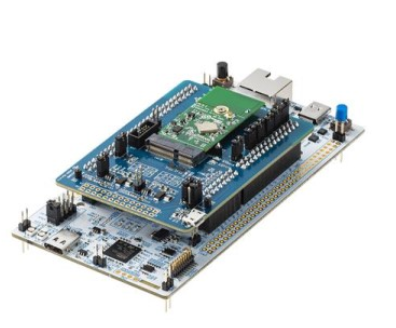
  Murata, a leading electronics manufacturer, in collaboration with Infineon are pleased to announce a new IoT development solution. This comprehensive innovation allows Murata’s Infineon-based Wi-Fi® and Bluetooth® modules to seamlessly integrate with a wide range of STM32 Nucleo-144 boards, helping to reduce the time-to-market for many wireless-enabled applications.
Murata’s Latest Partnership Aids IoT Development, Enabling M.2 Wireless Module Integration for STM32 Nucleo Boards

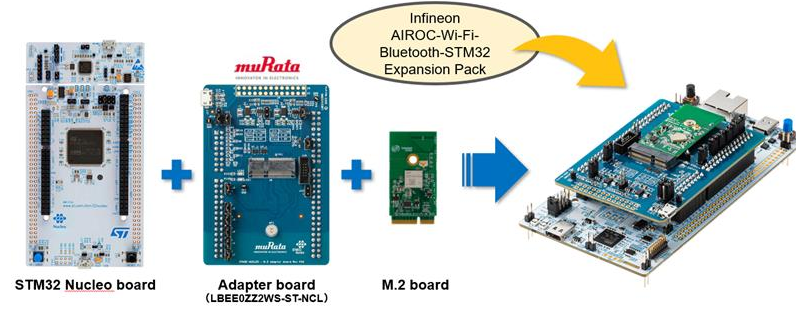
  The joint project is built on the collaboration with Infineon and Murata. / By combining each company’s extensive expertise, the collaboration has engineered a complete hardware and software solution that addresses a number of IoT development requirements. At its core, the platform solution allows STM32 microcontroller to connect Murata M.2 wireless modules featuring Infineon chipsets. Providing the hardware connection is Murata’s new Nucleo-144 to M.2 adapted board, while software integration is enabled through Infineon AIROC™ STM32 Expansion Pack. Whether you are evaluating low-power implementations, such as wearables and battery-powered devices, or high-performance deployments, such as industrial equipment and smart homes, this exciting solution creates a more efficient evaluation process.

  Murata Nucleo-144 to M.2 Adapter board

  Providing physical M.2 support for STMicroelectronics STM32 Nucleo board for microcontrollers, including the popular STM32U5 and STM32H5 series, is the Murata Nucleo-144 to M.2 adapter board. This innovative PCB-based adapter effortlessly mounts to the STM32 and features a convenient top-mounted M.2 socket. The M.2 dock grants effortless physical integration and swapping of Embedded Artists Murata M.2 modules which use Infineon chipsets. This allows the STM32 to accept a wide range of Wi-FiWi-Fi® and Bluetooth® combination units, including Wi-Fi 4, Wi-Fi 5 and industrial grade modules.

  AIROC™ STM32 Expansion Pack

  Produced by Infineon, a leading global semiconductor manufacturer, Infineon AIROC™ STM32 Expansion Pack provides the framework required to facilitate the Murata hardware. Using the Common Microcontroller Software Interface Standard (CMSIS), the AIROC™ STM32 Expansion Pack enables the integration of Infineon based Wi-Fi® and Bluetooth® module with STM32 STM32Cube ecosystem, including STM32CubeMX tool. Within the semiconductor industry, CMSIS establishes a consistent approach for software components, hardware parameters and code, helping to increase development productivity. Documentation, libraries and example projects are also available on Infineon’s dedicated Expansion Pack GitHub page,helping to support the quick deployment of your hardware environment.

  Innovation Through Collaboration

  Through the Infineon AIROC™ STM32 Expansion Pack, engineers can leverage an effective design environment to evaluate a range of Murata M.2 wireless modules (featuring Infineon chipsets) with STM32 Nucleo boards. With full support from dependable hardware, extensive documentation and example libraries, this comprehensive solution is the perfect tool for accelerating IoT development across an extensive variety of applications.
Murata’s Latest Partnership Aids IoT Development, Enabling M.2 Wireless Module Integration for STM32 Nucleo Boards

  Comment from Infineon

  Neil Chen, Director, Wi-Fi Product Line Marketing, IoT Compute and Wireless Business Unit at Infineon said “To reduce the barrier to entry for first-time IoT developers, semiconductor and module companies must come together to offer simple, easy-to-use and ease-to-productize solutions to market. Our collaboration with Murata does just that by leveraging our industry-leading AIROC™ Wi-Fi and Bluetooth portfolio to simplify the development of next-generation IoT products for a variety of applications.”

  Comment from Murata

  Masatomo Hashimoto, Director, Connectivity Module Division, Communication and Sensor Business Division, Murata Manufacturing Co. Ltd., said “We are excited to collaborate with Infineon, a global leader in semiconductors in the IoT and power systems to deliver this innovation. Customers face many barriers when bringing connectivity products to market, but this partnership provides a solution for a variety of development challenges and reduces time-to-market for a wide range of applications.”

("Note: The information presented in this article is gathered from the internet and is provided as a reference for educational purposes. It does not signify the endorsement or standpoint of our website. If you find any content that violates copyright or intellectual property rights, please inform us for prompt removal.")

Online messageinquiry

reading
Murata:SCH16T-K20 High-Precision 6-Axis IMU for Robotics and Camera Systems
  Murata Manufacturing Co., Ltd. has announced the expansion of its SCH16T series of high-performance inertial measurement units (IMUs) with the introduction of the SCH16T-K20, targeting industrial, prosumer, and consumer markets worldwide. Designed for OEMs in robotics, drones, and camera systems, as well as IMU module manufacturers and system integrators requiring safety-critical IMUs, the SCH16T-K20 delivers market-leading precision, mechanical robustness, and reliability.  In demanding inertial measurement applications such as dead-reckoning navigation as well as drone and camera stabilization, small measurement errors can accumulate over time leading to unpredictable measurement results. In these applications, key IMU parameters such as noise density, offset bias drift, and vibration rectification ultimately limit the end-application performance and achievable response speed. Murata improves all the key areas with the new SCH16T-K20, which features a brand-new MEMS accelerometer and improved gyroscope temperature calibration.  The SCH16T-K20 is a 6 axis IMU with a typical gyroscope noise density of 0.0004 (°/s)/√Hz, gyroscope bias instability of 0.3 °/h, and accelerometer noise density as low as 33 µg/√Hz. Like all other SCH16T products, the SCH16T-K20 has a wide operating temperature range from -40 °C to +110 °C, a supply voltage of 3.0–3.6 V, and I/O voltage of 1.7–3.6 V, and a compact size of 0.46 × 0.53 × 0.11 inch (11.8 × 13.4 × 2.9 mm).  The driver behind the SCH16T-K20 accelerometer performance improvement is the brand-new accelerometer MEMS based on Murata’s proven 3D MEMS technology. The new MEMS uses a double-differential measurement principle, familiar from current SCA3400 and legacy SCA103T series sensors. The double differential measurement enables SCH16T-K20’s market leading low noise density, as well as thermal and lifetime stability.  The SCH16T-K20 also includes an enhanced version of the market-leading low-noise SCH16T gyroscope, now tuned specifically for the -40 °C to +85 °C temperature range to enable low offset bias shift across that range. All SCH16T series products are carefully validated with a test set based on AEC-Q100 operating temperature Grade 1 (-40 °C to +125 °C) standards*, ensuring reliable operation over a wide temperature window. The series sensors include market-leading self-diagnostic features, making them suitable for safety-critical applications. Murata’s unique MEMS stands out in the competitive IMU market for its exceptional mechanical resilience to shocks and vibration rectification. The series’ robust design and reliability contribute to longer device lifespans and reduced waste.  The SCH16T-K20 becomes the highest-performing variant in the SCH16T lineup while maintaining pin-to-pin and software compatibility. This compatibility makes integration of different SCH16T variants easy for OEMs and module designers. Mass production of the SCH16T-K20 is scheduled to begin in the first half of 2026. Murata will continue developing sensor solutions aligned with evolving market demands, contributing to safer, more sustainable, and higher-performing technologies across industrial and consumer markets.
2025-12-26 16:09 reading:344
Murata Launches World’s First Inner Cavity-Structure Ultra-Low-Loss LCP Flexible Substrate, Achieving Dk below 2.0, Contributing to 6G Realization
  Murata Manufacturing Co., Ltd announces the World’s First LCP (liquid crystal polymer) flexible substrate with an Inner Cavity structure, ULTICIRC, and has already begun mass production*. Murata’s proprietary design incorporates an Inner Cavity within the substrate to achieve a dielectric constant (Dk) below 2.0, dramatically reducing transmission loss.Cross-Section Image  With 6G expected to leverage the FR3 (Frequency Range 3) band—roughly 7–24 GHz—substrates with minimal transmission loss are essential to enable high-speed, high-capacity communications at high frequencies. At the same time, demand is growing for thin, space-saving flexible substrates that support free-form mechanical design to meet the ongoing miniaturization of smartphones and communication equipment. Murata has provided LCP flexible substrates with excellent high-frequency characteristics, featuring a proprietary high-performance resin that eliminates spring-back and an adhesive-free, one-shot press multilayer lamination process; building on this expertise for 6G readiness, Murata has developed and launched ULTICIRC. Conventional flexible substrates faced the challenge that making them thinner resulted in increased transmission loss, but this product incorporates an Inner Cavity structure within the substrate, achieving a dielectric constant (Dk) below 2.0, which is significantly lower than Murata's conventional products, enabling both thin profiles and ultra-low transmission loss simultaneously.  Furthermore, thanks to an adhesive-free proprietary manufacturing method and the excellent barrier properties of LCP, the Inner Cavity structure maintains high moisture resistance.  For inquiries regarding this product, please contact us.
2025-12-18 16:00 reading:476
Murata develops integrated passive device for Semtech’s SX126X family
  Murata Manufacturing Co., Ltd. has developed a new integrated passive device (IPD) for use with the Semtech LoRa Connect™ SX126x family, which includes the SX1261, SX1262, and LLCC68 products. Using a proprietary low-temperature co-fired ceramic (LTCC) process, Murata has successfully replaced a series of discrete matching components of the SX1261/2 reference design with a single 2.00mm x 1.25mm size LTCC component.  The IPD enables SX1261/2 radio designers to optimize for both size and performance using two dedicated parts. The LFB21892MDZ7F957 is optimized for US and European ISM bands, delivering the full output power for the US FCC bands. The LFB21892MDZ7F821 is optimized for Eurocentric designs that need to maximize the efficiency performance.  “The Murata IPD offers the most efficient development path to realizing the full performance of the SX1261/2, featuring a miniaturized form factor that can significantly reduce board space,” says Arthur Kiang, Product Manager, RF Components, Murata. “The reduction in the number of matching components enables lower material costs and simplifies the design process, leading to shorter lead times. This integration also lowers the probability of soldering and manufacturing issues, as there is only one component to monitor in production.”  “Semtech’s LoRa Connect™ SX126x family has become the trusted choice for LoRaWAN® networks and long-range IoT connectivity in applications from smart metering to industrial sensing,” says Carlo Tinella, product marketing director of wireless and sensing products at Semtech. “Murata’s IPD solution demonstrates the strength of our LoRa® ecosystem, helping radio engineers accelerate development while optimizing for both miniaturization and regulatory compliance. This partnership streamlines the path from design to deployment for millions of IoT devices being deployed globally.”  Product samples are currently available, with mass production of the IPD commencing shortly.
2025-11-28 17:33 reading:490
Murata expands lineup of high cutoff frequency chip common mode choke coils in 0504-inch size for automotive high-speed differential interfaces
2025-11-10 17:12 reading:530
  • Week of hot material
  • Material in short supply seckilling
model brand Quote
CDZVT2R20B ROHM Semiconductor
MC33074DR2G onsemi
RB751G-40T2R ROHM Semiconductor
BD71847AMWV-E2 ROHM Semiconductor
TL431ACLPR Texas Instruments
model brand To snap up
IPZ40N04S5L4R8ATMA1 Infineon Technologies
BU33JA2MNVX-CTL ROHM Semiconductor
STM32F429IGT6 STMicroelectronics
ESR03EZPJ151 ROHM Semiconductor
BP3621 ROHM Semiconductor
TPS63050YFFR Texas Instruments
Hot labels
ROHM
IC
Averlogic
Intel
Samsung
IoT
AI
Sensor
Chip
About us

Qr code of ameya360 official account

Identify TWO-DIMENSIONAL code, you can pay attention to

AMEYA360 weixin Service Account AMEYA360 weixin Service Account
AMEYA360 mall (www.ameya360.com) was launched in 2011. Now there are more than 3,500 high-quality suppliers, including 6 million product model data, and more than 1 million component stocks for purchase. Products cover MCU+ memory + power chip +IGBT+MOS tube + op amp + RF Bluetooth + sensor + resistor capacitance inductor + connector and other fields. main business of platform covers spot sales of electronic components, BOM distribution and product supporting materials, providing one-stop purchasing and sales services for our customers.

Please enter the verification code in the image below:

verification code